Sliders

Showing posts with label Durian. Show all posts

Monday, July 20, 2015

10 Fruits That Help Lower Blood Pressure Levels

The high potassium in some fruits can help lower blood pressure and reduce the risk of heart disease. Keep your blood pressure under control and keep your potassium levels in check by reaching for any of these fruits.

1. Bananas

photo link

Why do we see tennis players eat bananas during a match? Bananas are best-known for their potassium content which helps replenish lost fluids from sweating so much during a game. It also adds energy and helps prevent cramps.

2. Avocados

photo link

Considered as one of the most nutritious fruits, avocados are excellent sources of fiber, vitamin K, and folate, and very good sources of potassium, pantothenic acid, and vitamins C and E. One cup of cubed avocados can provide the body with a good amount of the B vitamins, as well as copper, magnesium and manganese.

3. Guavas

photo link

The guava, considered as one of the superfoods, is the fruit with the highest vitamin C content. In addition to being an excellent source of fiber and vitamin A, it is also a very good source of vitamin B6, potassium, copper and manganese.

4. Breadfruit

photo link

The breadfruit is another fruit which needs to be cooked before it is consumed. Every 100 grams can supply the body with half of the DV of vitamin C. It is also loaded with 20% of the DV of fiber and is a very good source of potassium, magnesium and thiamine.

5. Tamarinds

photo link

The tamarind is a tart fruit which is typically used as a spice and souring agent. It is an excellent source of thiamine, magnesium, fiber, and potassium. It is also rich in iron, phosphorus and niacin and one of the few fruits packed with calcium.

6. Durian

photo link

The king of fruits boasts of its high vitamin C content. It is also rich in vitamins B1 and B6, fiber, folate, magnesium, and manganese, and is blushing with 436 mg of potassium for every 1 cup of chopped or diced fruit.

7. Plantains

photo link

Plantains are fruits which can be mistaken for bananas. They are classified as fruits but are considered as vegetables as they need to be cooked before they can be eaten. Plantains are very high in vitamins A and C. They are also packed with vitamin B6, magnesium, and fiber and almost a quarter of the daily value of potassium.

8. Custard-apple

photo link

Custard-apple, also known as bullock’s heart contains almost the same amount of potassium as bananas. It can also provide the body with an excellent supply of vitamins C and B6, and fiber.

9. Kiwifruit

photo link

The kiwifruit is an excellent source of vitamins C and K and fiber, a very good source of folate, potassium and copper and a good source of the B vitamins and other important nutrients. Like the tamarind, it is one of the few fruits which contain the bone-friendly nutrient—calcium.

10. Purple Passion Fruit

photo link

Granadilla, also known as purple passion fruit is a Brazil native. You’ll get half of the daily value of vitamin C and fiber and a quarter of the DV of vitamin A for every 100 grams of this subtropical fruit. It can also contribute about 348 mg of potassium.

Tuesday, June 9, 2015

10 Exotic Spiky Fruits

You may like or hate some of them because of the scent or taste. Let your tongue be the judge - grab one and have a bite or two.

Rambutan

photo link

The Rambutan (Nephelium lappaceum) is native to the Philippines, Malaysia, Thailand and other regions of tropical Southeast Asia. The fruit is ovoid, single-seeded berry with pinkish red skin. The thin, leathery, spiky rind grows to about 3–6 cm long and 3–4 cm broad, hanging in a cluster of 10–20 together. Within is the fruit flesh; whitish or very pale pink, translucent, juicy with a sweet or sour taste (much like a grape). Rambutan is closely related to lychee, longan, and mamoncillo.

Soursop

photo link

Here’s one spiky fruit that many people love. Soursop (Annona muricata), also called Graviola, is a large, spiny, green tropical fruit with a soft, sweet, white flesh. The sweet flavor is described as a mix of strawberry and pineapple. The fruit size ranges from 10-30 cm (4 to 12 in) long and up to 15 cm (6 in) in width, and weighs up to 4.5-6.8 kg (10 or 15 lbs). The pulp is used to make teas, juices, sorbets, candy and ice cream flavorings.

Gac

photo link

Gac (Momordica cochinchinesis) is a fruit native to Southeast Asia but is consumed mostly in Vietnam and Laos. For centuries, the fruit is traditionally used both as food and medicine. It is known as red melon, baby jackfruit, spiny bitter in English. Its ovoid fruit turns to brilliant red-orange hue when it ripens. The skin is covered in small, short spines, while its red core consists of clusters of fleshy pulp and seeds. The flesh has a unique taste - reminiscent of cantaloupe with hints of green melon and carrot.

Breadfruit

photo link

Breadfruits (Artocarpus altilis) are round to ovoid tropical fruits measuring 15-20 cm long and about 20 cm across. It has a harsh, sandpaper-like green rind that turns to yellowish-green with some red brown parts when ripe. The interior part of the fruit is white, starchy and somewhat fibrous. When fully ripened, it becomes too soft, less starchy and sweetly fragrant that can be eaten raw or cooked. Breadfruit is related to breadnut and jackfruit.

Horned Melon

photo link

The Horned Melon (Cucumis metuliferus) is known by various names including kiwano, hedged gourd, jelly melon, blowfish fruit, and English tomato. When ripe, this unusual-looking fruit has a yellow-orange skin with prominent spikes or horns and green jellylike flesh. The horned melon has a sweet and tart, banana-lime taste. The brighter the orange skin, the sweeter the flesh of the fruit. It can be eaten at any stage of ripening.

Durian

photo link

Durian is regarded by many people in southeast Asia as the "king of fruits". The exotic fruit is distinctive for its large size, strong penetrating odor, which earned it the title, “the fruit that tastes like heaven but smells like hell.” The fruit's shape ranges from round to oblong; can grow up to 30 cm long and 15 cm wide and weigh up to three kg.

It has green to brown husk (rind) covered with sharp, prickly thorns. Depending on the species, it has a pale yellow to red flesh. The edible flesh tastes like "a rich custard highly flavored with almonds". Indeed, durian is king in taste, smell and spikes.

Pulasan

photo link

The Pulasan (Nephelium mutabile) is a small spiky fruit native to Malaysia. The name pulasan comes from the Malay word pulas (twist). It has various common names, including kapulasan in Indonesia, ngoh-khonsan in Thailand, and bulala or panungayan in the Philippines. The fruit is ovoid, 5-7.5 cm long, dark red, with thick, leathery and spiky rind. Inside is the white or yellowish-white, juicy flesh (aril).

The skin ranges in color from red to black and is harder to tear apart. It has a sweeter taste than the rambutan and lychee and somewhat similar to that of almonds. It is usually confused with its hairy cousin, the rambutan. Compared to the rambutan, the pulasan lacks the hairy spines. It is also bigger, sweeter and the flesh does not stick to its seed.

Jackfruit

photo link

The Jackfruit (Artocarpus heterophyllus)is known as the largest tree-borne fruit in the world. It is native to parts of South and Southeast Asia, and is believed to have originated in the southwestern rain forests of India. The fruit is oblong to cylindrical and typically 30 to 40 cm in length and weigh 4.5 to 30 kg. The thick skin is green or yellow when ripe and the rind secretes white sticky latex.

The interior consists of non-edible “rags” and large sweet-smelling yellow flesh that encloses a smooth, oval, light-brown seed. The succulent, aromatic, and flavorful flesh are eaten fresh or cooked. It can also be made into jams or preserves and chips as well.

Marang

photo link

The Marang (Artocarpus odoratissimus), also called madang, and tarap, is a medium-sized fruit closely related to jackfruit, cempedak and breadfruit. Its round to oblong fruit can grow to as much as 15–20 cm long and 13 cm broad, and can weigh about 1 kg. The thick skin is covered with soft, broad spines that becomes hard and brittle as the fruit matures.

The ripe fruit can be opened by using the hands - twisting and gently pulling the skin. The fruit core resembles that of the jackfruit but with fewer “rags”. The edible areas are white, juicy, fragrant and with small seeds. Compared to durian, Marian has a more appealing scent and a sweeter flavor. The fruit should be eaten quickly as it fast loses its flavor and the fruit oxidizes.

Cempedak

photo link

The Cempedak (Artocarpus integer) is often confused with the jackfruit. The sausage-shaped fruit is similar to the jackfruit in appearance but smaller. The interior can also be mistaken as marang but with bigger arils. The fleshy, edible aril has a green color and turns slightly yellowish as it's ripe.

The fragrant taste is similar to the breadfruit and jackfruit with a hint of durian. The flesh is rather perishable, so it should be consumed quickly. Unlike the jackfruit which usually needs a knife to break open, a ripe cempedak fruit is soft and can be opened using the hands. It can be fried or made into delicious cakes.

Monday, July 21, 2014

10 Wonderful Exotic Fruits – Part Three

10 more delicious and healthy exotic fruits.

These wonderful exotic fruits are not only healthy and delicious ones – they do have interesting and helpful medicinal properties!

Loquat

photo link

The Loquat (Eriobotrya japonica) is a subtropical evergreen fruit tree native to China. It was introduced into Japan possibly a thousand years ago, and reach California in the 1870’s. Today, loquat trees are also grown in many countries including Mexico, Portugal. Brazil, India, Pakistan, Australia, France, Italy, Israel, Egypt and other Mediterranean countries.

The fruits growing in clusters, are oval about 2.5-5 cm long having smooth yellow or orange skin. The sweet and juicy pulp comes in white, yellow or orange depending on the cultivar. The taste is like a cross between a passion fruit and a guava The fruit may contain three to five large brown seeds. The skin, can be removed easily if the fruit is ripe. The fruit can be eaten raw, preserved dried or stewed. Loquat is rich in vitamin A, dietary fiber, minerals, pectin and anti-oxidants.

Feijoa

photo link

The Feijoa (Acca sellowiana) is a flowering plant that is indigenous to South America. The fruit tree, also called pineapple guava and guavasteen was first cultivated in New Zealand in the early 1900s.The pear-shaped feijoa fruits are about .75-3.5″ in long with waxy skin. The fruit emit’s a strong aromatic scent and taste like a cross of guava and pineapple. Just like guava, the fruit pulp has a gritty texture and becomes gelatinous when ripe. How to eat the fruit? Just cut it in half, then use a spoon to scoop out the pulp. The Feijoa fruit is a good source of fiber, vitamin C, folate, and proanthocyanins, a highly effective antioxidant.

Chontaduro

">photo link

The Chontaduro (Bactris gasipaes), is a palm native to Central and South America. The fruit growing in clusters are harvested from the top of this palm that grows to 20 m or taller. Chontaduro fruit tastes like a cross between roasted chestnuts and baked potato. It may be eaten raw or can be stewed in salted water. The palm fruit is rich in Vitamin C, vitamin A, minerals (calcium, phosphorus, iron) and proteins.

Passion fruit

photo link

The Passion fruit (passiflora edulis) is native to Central America where Brazil is the main producing country. This climbing vine with nearly round or ovoid fruit can grow 15 to 20 ft. The fruit, yellow or dark purple in color; has thick outer skin and inside is a thick mucous-like membrane covering as many as 250 small, black seeds. The fruits are edible and the pulp tastes sweet. If eaten raw, cut the fruit in half and spoon out the pulp. Passion fruit is packed with vitamins A and C, a good source of fiber, and contains potassium and iron. It has also medicinal uses such as easing headaches, ulcers, anxiety, urinary tract infections, and heart attacks.

Black Sapote

photo link

The Black Sapote (Diospyros digyna), also called Black Persimmon, Chocolate-Fruit, is a Tomato-like fruit native in Mexico and Guatemala. It is also grown in Florida, Cuba, Hawaii, The Philippines, and the Dominican Republic. The fruit is shining dark green, about 10 x 13 cm. in size having a firm rind. The edible pulps when ripe are sweet and taste like mild chocolate. The fruit may be eaten raw or use in desserts. Black sapote is rich in vitamin C and a good source of vitamin A, potassium and minerals.

Soursop

photo link

The Soursop (Annona muricata) is an exotic fruit native to tropical America. Today, it is cultivated in many countries in South Asia. The fruit comes in many shapes like oval, round and irregular shapes. This prickly fruits has a white, creamy, juicy flesh that contains an average of 60 to 100 black-brown seeds. As the name suggests, the fruit is sour and acidic in taste. It may be eaten raw or squeezed for juice. The pulp is high in carbohydrates, Vitamin C, Vitamin B1, Vitamin B2, potassium, calcium and dietary fiber. Other names for the fruit include: Graviola in Brazil, Guanabana in Spanish and Guyabano in Filipino.

Guarana

photo link

The Guarana is a flowering shrub native to Venezuela and Brazil. The tree grows to 12 m in high. The bright-red fruit growing in clusters is small (about the size of a coffee bean) and round in shape. The powder of the fruit is bitter when consumed alone but takes a pleasant and delicious taste when mixed with water. The guarana fruit contains about twice the caffeine found in coffee beans. Use as a nutritional supplement, it is an effective energy booster. In Brazil, GuaranĂ¡ syrup is marketed as energy drinks and is used as an ingredient in carbonated soft drinks.

Lychee

photo link

The Lychee (Litchi chinensis), is a medium-sized tropical fruit tree native to parts of China, India, the Philippines, Taiwan, and Indonesia. The fleshy fruits are rather odd-looking; The exterior part of the fruit roughly-textured rind reddish in color, the inside contains a layer of sweet, juicy, translucent white flesh. The flesh is eaten raw or can be added to different dessert dishes. Lychee fruits are low in calories and are cholesterol free. It is rich in vitamin C, dietary fiber and is a good source of B-complex vitamins such as thiamin, niacin and folates.

Camachile

photo link

The Camachile (Pithecellobium dulce), also known as- Guamachil, Madras Thorn, Monkey Pod, Manila Tamarind, Kodukkai Puli/Kodi-kai puli, Kona Puliyankai , Sweet Tamarind, Jungle Jilebi, Bilayati Imli, is nativeto Mexico, Central Asia, Guam, India, Philippines, Caribbean, and Florida. The tree grows to about 5 to 8 m and bears greenish-white, flowers 12 cm (4.7 in) long. The flowers produce an edible, curved or twisted pods about 12 cm long. The seeds are black. The seedpods can be eaten raw or prepared as a beverage. Camachile is used in treating Venereal diseases and is also prescribed for diabetics.

Durian

photo link

Durian known in southeast Asia as the “king of fruits”, is native to Malaysia, Brunei, Philippines and Indonesia. The fruit growing to about 30 centimeters long and weighing from one to three kilograms is oblong to round in shape. The edible pulp emits an indescribable odor. Durian is a highly nutritious fruit because it is rich in vitamin B, C and E and is a good source of carbohydrates, proteins, and fats.

Thursday, June 27, 2013

Philippines Medicinal Plants Part Four

The Philippines is blessed with more than 500 medicinal plants, and below is another list of 10 medicinal plants approved by the Philippine Department of Health (DOH) as an alternative medicine in treating particular disorders.

Part Four in a series of articles about the Philippines’ common medicinal plants.

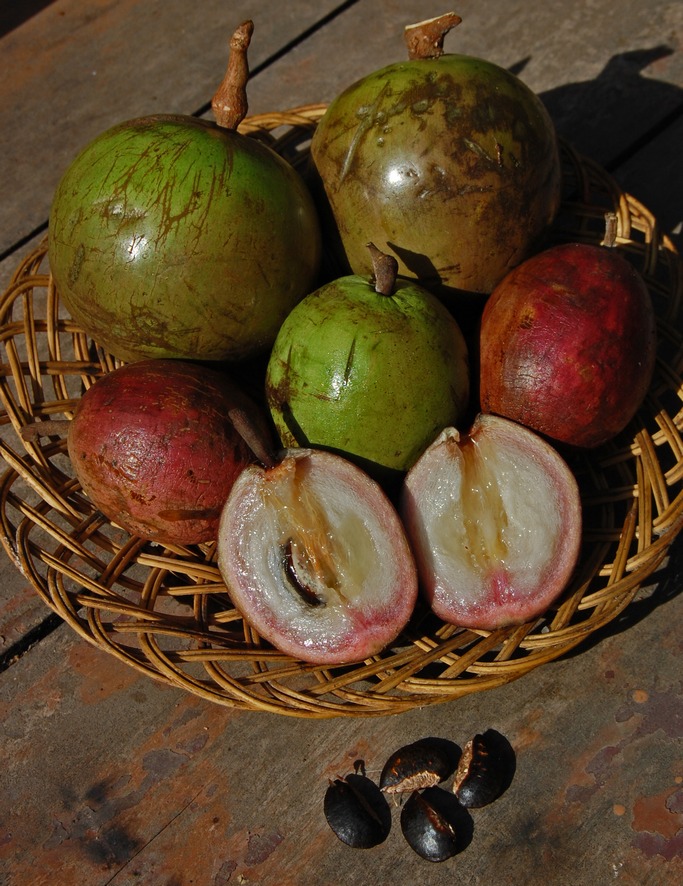
Caimito — Chrysophyllum cainito Linn.– Star Apple

photo link

The star apple tree is erect, growing to about 8-30 m tall, with and a dense, broad crown. The alternate, slightly leathery evergreen leaves are elliptic about 2 to 6 in (5-15 cm) long. The flowers are purplish-white, small and bunched in the axils of leaves. The shiny and purplish or light-green skinned fruit is large and rounded, about 6 to 10 cm in diameter. The flesh is fibrous, sweet, and pleasant tasting.

For its medicinal purposes, the seeds, leaves, bark, fruit are utilize. Below are some of star apple’s medicinal usage:

* Decoction of the bark is use to relieve Dysentery
* The ripe fruit is good for easing up inflammation in laryngitis and pneumonia.
* The slightly unripe fruits are eaten to relieve intestinal problems.
* A decoction of the bark is drunk as a stimulant.
* The bark latex used on abscesses
*Decoction of bark used in the treatment of dysentery, diarrhea, gonorrhea, and hemorrhages.
* The bitter, pulverized seed used as tonic, for fevers and diarrhea.
* As a decoction is gargled to relieve angina.
* A decoction of the leaves, is taken as a pectoral.
* The medicinal tea made out of the leaves is used diabetes and rheumatoid arthritis.

Chico–Achras sapota Linn.–Chiku Tree, Sapodilla

photo link

The chico tree is an upright, very branched, slow growing evergreen tree, growing up to 8 meters tall. The leaves are oblong, are medium green and glossy, 3 to 4-1/2 inches long and 1 to 1-1/2 inches wide. Flowers are small. hairy outside, about 3/8 inch in diameter. They are borne on slender stalks in the axil of the leaves. The fruit is brown, large, fleshy, ellipsoid, 5-10 cm in diameter. It contains black, hard, glossy seeds.For medicinal purposes: Bark, seeds, fruit are utilized.

Medicinal Uses:

* Decoction of the bark or leaves good for relieving diarrhea, dysentery, fever coughs and colds.
* A tea made with the green fruit and the flowers is drunk to relieve pulmonary ailments
* Crushed seeds help expel bladder and kidney stones.
* Seeds when ground with water, acts as diuretic.
* Seed kernel oil used as dressing for falling hair.
* Seed infusion used as an eyewash.
* Decoction of leaves used for treating wounds, hemorrhage, and ulcers.
* A paste made from the seeds is a good antidote for venomous stings and bites
* A tea made with sapodilla and chayote leaves is thought to be good in lowering blood pressure.
* The latex can be used as a filling for tooth cavities.

Curly dock –Rumex crispus –Yellow Dock, Rumex

photo link

Curly dock, sometimes referred as “poor man’s ginseng”, is a small, erect and scarcely branched plant reaching to about 30 to 90 cm in height. It has branched stem, on average growing up to 3 feet high. The leaves are crisped at their edges vary in shapes. The upper leaves are narrowly oblong about 7 to 15cm long while the lower leaves bears elongated shape grows from 2 to 30 cm long. The yellowish roots are 8 to 12 inches long, about 1/2 inch thick.

Medicinal uses:

* Decoction of roots relieved fevers.
* Fresh bruised roots applied externally is effective against skin rushes, eczema, boils, skin cuts, wounds, dermatitis burns, and bleeding hemorrhoids.
* Yellow dock is effective in the treatment of tapeworms and roundworms.
* Used as treatment for liver problems, internal bleedings, gall bladders disorder and arthritis.
* Decoction of roots used in the treatment of psoriasis, jaundice, constipation.
* Alleviate acute inflammation of nasal passages.

Damong Maria — Artemisia vulgaris Linn. — MAIDEN WORT

photo link

Damong Maria is an erect, aromatic, hairy, tall-growing perennial herb growing to 0.5 to 1meter in height. The stems are smooth, angular, leafy, branched dark green hue on the upper surface growing up to 14 cm long. The flowers are in small with numerous flower heads oval heads with either reddish or pale yellow in color. The fruit is minute.

Medicinal Uses: Leaves and Flowers are Utilized

* The juice of the leaves used externally effective against scabies, herpes, eczema, and wounds.

* Decoction of leaves effective against abdominal ailments.

* Decoction of leaves used for intestinal deforming.

* Leaf poultice alleviates headache and skin ailments.

* Decoction of leaves and flowering tops taken daily are considered expectorant.

* Decoction of dried leaves controls asthma and dyspepsia.

* Young leaves used for anorexia.

* Mixture of the aromatic leaves used to induce menstruation.

* Juice of leaves applied to head of young children for the prevention of convulsions. Dandelion–Taraxacum officinale Weber

photo link

Dandelion is a perennial herb. The leaves are 5–25 cm long, simple and smooth, entire or lobed, stalkless, toothed and divided like feathers. The flower heads are yellow to orange about 2–5 cm in diameter and containing many single-seeded fruits called achenes. Medicinal Uses:

* Decoction of roots and leaves used for liver problems.
* Decoction of roots used as a digestive aid, food stimulant and for gallbladder function.
* Decoction of leaves used as a diuretic.
* Tea, made from fresh leaves, flowers and buds effective urinary disorders.
* Decoction of leaves eased abdominal colic pains.
* Leaf poultice for headache and skin ailments.
* Decoction of leaves used to induce menstruation.
* Decoction of root used for eczema, acne, scurvy, swelling and various skin problems.
* Fresh juice is applied externally to fight bacteria and help heal wounds.
* Decoction of roots used for jaundice, cirrhosis, hypoglycemia, dyspepsia
* Juice of the stalk used to remove warts.
Dayap – Citrus aurantifolia (Christm.) Swingle –LIME

photo link

Dayap is a shrub or a small tree about 2-4 meters high with many short stiff sharp spines 1 cm or less long. The evergreen leaves are pleasantly aromatic, alternate, oblong-ovate to elliptic, 4 to 6 centimeters long. Racemes are short, bearing few flowers, white and fragrant. The fruit is round, or slightly elliptical, 3-5 cm in diameter, greenish-yellow and thin-skinned. Seeds small, smooth, plump, egg-shaped, with white embryos (polyembrionic).

Medicinal Uses: Parts used Roots and Leaves

* Decoction of roots effective against dysentery
* Decoction of roots and bark reduces fever.
* Juice effective as mouthwash and gargle for sore throat.
* Fresh juice used to clean wounds.
* Decoction of leaves drunk used for gastrointestinal ailments.
* Decoction of roots used for eczema, fevers, acne, scurvy, kidney problems.
* Pounded leaves as poultice used applied to ulcer wounds.
Dila-dila –Elephantopus scabes –Prickly-leaved Elephant’s Foot

photo link

Prickly-leaved Elephant Foot is an erect, firm, relatively rough hairy aromatic plant growing to about 30 to 60 cm in height. The plant’s stems are forked, and rigid. Leaves are typically rosette and aoblong-ovate in shape about 10-25 cm long. Elephant’s foot has purple flower, 8-10 mm long with each flower head contains about 4 flowers. The flowering heads many-crowded in each cluster. It bear fruits that don’t open (achenes).

Medicinal Uses: Entire plant utilized either fresh or dried

* Pounded fresh leaves as poultice used for the treatment of snakebites, skin swelling, eczema boils.
* Decoction of roots used to eased hemorrhoids, diarrhea, fevers, dysuria, bronchitis.
* Juice out of pulverized leaves applied to scalp helps slow down hair loss.
* Flowers used in treating liver problems, hepatitis, beriberi, scabies chest pains.
* Decoction of roots used to prevent vomiting
* Decoction of leaves boiled is drunk to ease stomach discomfort.
* Decoction of roots and shoots used in postnatal care to restore the womb after delivery

Dita — Alstonia scholaris — White Cheese Wood

photo link

White cheese wood is a medium to large tree, growing to about 40 m high found throughout tropical Eastern Asia. The bark is grayish, has a furrowed trunk and branchlets are copiously lenticellate. Leaves come in whorls of 3-10; Leaves are simple, opposite and ovate, cordate at base and rounded at the apex. Flowers are crowded, numerous 7-10 mm long white, cream or green. Fruits are fleshy follicles, green; 4-5 mm diameter, 20-30 cm long. Seeds are numerous, brown, oblong, about 3-4 mm long and with a tuft of hairs 7-13 mm long.

Medicinal Uses: Parts utilized Root, Latex, Flower and Leaves

Decoction of roots and leaves used for the treatment of fevers, diarrhea, bronchitis and dysuria. Decoction of leaves effective remedy for beriberi. Poultice of young leaves used for ulcers and skin diseases. Decoction of root eases hemorrhoids. Decoction of leaves as wash used in treating eczema. Decoction of the bark used as tonic, ant choleric, febrifuge and vulnerary. Mixture of juice and oil used as drops for earaches. Milky latex used externally used for boils. Flowers used for cough, bronchitis, liver problems, and eye problems.

Don Manuel – Hamelia patens Jacq.–Scarlet Bush

photo link

Scarlet Bush is a large, semi-woody perennial shrub reaching up to 3 meters in height. Its leaves are deeply veined about 20 cm long. Flowers are tubular, reddish-orange in color. The fruit is a small juicy red berry and turns black when ripe.

Medicinal Uses:

* Effective against insect bites.
* Boiled leaves as poultice used for bruises, wounds, sores, burns, sprains and strains.
* Mixture of leaves drunk to relieve fevers and diarrhea.
* Decoction of leaves also used for intestinal parasites, scurvy, scabies, rheumatism and headaches
* Also effective for menstrual disorders.

Duryan–Durio zibethinus Murr.–DURIAN

photo link

In Southeast Asia, considered the “King of Fruits,” Durian tree is usually erect with short, straight peeling truck growing to (27-40 m) in height. The evergreen, alternate leaves are elliptic to oblong, 10 to 20 centimeters long. The fruits are ovoid or ovoid-oblong to nearly round; can grow from 20 to 40 centimeters and weigh from 1 to 8 kilograms when ripe. Seeds about 2-6 cm long with glossy, red-brown color.

Medicinal Uses:

* Decoction of root and leaves effective in easing up fevers.
* Leaves are used in medicinal baths for jaundice.
* Externally, Fruit walls are used for the treatment of skin ailments.
* Decoction of leaves used for swelling.
* Decoction of leaves and roots used for fever, colds, phlegm.
* Leaf juice applied on head for fever.
* Fruit helps lower cholesterol.
* Fruits helps build muscles and a good source of raw fats.
* Fruits ease anxiety, depression, and insomnia
* Fruits used as aphrodisiac.